
7 Steps to Start Daily Stretching for Beginners
Last Updated: October 26, 2026
Quick Summary
Start daily stretching by committing to just five minutes on the floor, using seven beginner moves in order: cat-cow, child's pose, figure-four, hamstring stretch, neck and shoulder rolls, standing thigh stretch, and a cross-legged side reach. Hold each stretch 20 to 30 seconds, most days of the week, and anchor the routine to something you already do.
- The beginner routine takes about 10 to 12 minutes and covers your whole body.
- Hold each static stretch for 20 to 30 seconds and repeat two to four times per muscle group.
- Anchor stretching to brushing your teeth, a lunch break, or right after a workout.
- Never miss two days in a row, even if you only do the five-minute version.
- Stretching should feel like mild tension, never sharp pain, numbness, or joint pain.
Table of Contents
- Why Daily Stretching Is Worth the First Five Minutes
- Your Beginner Daily Stretching Routine: 7 Moves in Order
- How Long to Stretch Each Day (and How Often to Hold)
- Morning Stretches for Beginners: A 15-Minute Wake-Up Sequence
- Build a Daily Mobility Routine You Actually Keep
- Dynamic vs. Static Stretching: What to Do Before and After Activity
- Stretching Safety and Pain Guidance for Beginners
- Track Progress and Adjust Your Routine
- Frequently Asked Questions
Why Daily Stretching Is Worth the First Five Minutes
Daily stretching means moving your joints through their full range of motion with slow, controlled holds to improve flexibility and ease stiffness.
Flexibility comes from repetition, not intensity: stretch a little every day and your body adapts, while pushing too hard sets you back.
Below, we'll show you how to start daily stretching with seven moves, a 15-minute morning sequence, and a simple plan to make it stick. Order matters, warm muscles stretch better than cold ones, so the sequence moves from gentle spine work to bigger hip and leg stretches.
The American Council on Exercise guide to flexibility training makes the same point: consistency and proper form matter more than how far you push.
Your Beginner Daily Stretching Routine: 7 Moves in Order
This beginner daily stretching routine takes about 10 to 12 minutes and hits your whole body. Move slowly, breathe, and never bounce.
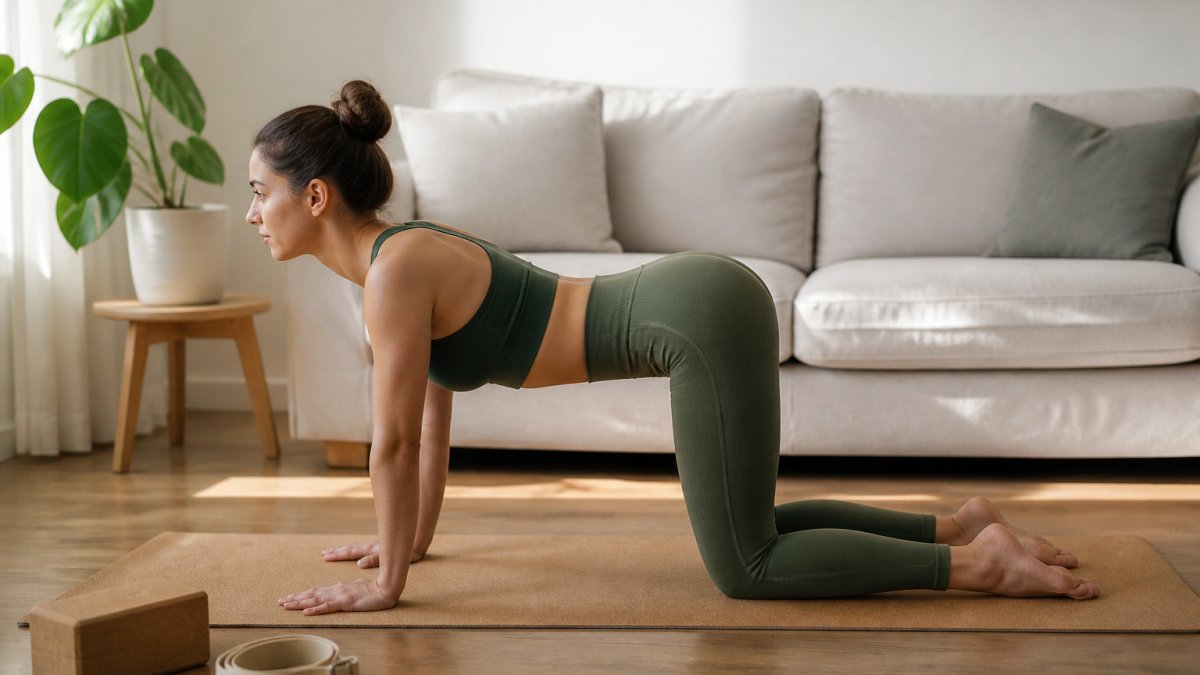
A comfortable mat makes floor work easier on your knees and wrists. Our Ananday Cork Yoga Mat gives you a grippy, cushioned surface for all seven moves.

Step 1: Cat-Cow on Hands and Knees
Start on hands and knees with wrists under shoulders and knees under hips. Inhale, drop your belly and lift your chest. Exhale, round your spine and tuck your chin.
Grip socks help you stay planted during hands-and-knees work. Our Jacquard Grip Yoga Socks keep your feet and hands from sliding.

Step 2: Child's Pose for the Spine and Back
From hands and knees, sit your hips back toward your heels and reach your arms forward. Rest your forehead down and breathe for 30 to 60 seconds. This gently lengthens the spine and back. If your hips feel tight, slide a block under them.
Step 3: Figure-Four Stretch for Hips and Pelvis
Lie on your back and cross one ankle over the opposite knee, forming a figure-four. Reach through and pull the bottom thigh toward your chest until you feel a stretch in the hip and pelvis. Hold 30 seconds per side, this is the hip stretch beginners feel fastest.
Step 4: Hamstring Stretch With a Strap or Block
Lie on your back and loop a strap around one foot. Keep the knee soft and raise the leg until you feel a gentle pull behind the thigh. Our Cork Yoga Block Set adjusts to three heights so you can support the leg without strain.

Step 5: Neck and Shoulder Mobility Rolls
Sit tall and slowly roll your shoulders back a few times, then tilt your head gently toward one shoulder and hold 15 seconds per side to loosen the neck and shoulders after a day at a desk.
Step 6: Standing Thigh Stretch at a Wall
Stand near a wall for balance. Hold one ankle behind you and press your hip forward until you feel a stretch in the front of the thigh. Hold 30 seconds per side, keeping your knees close together.
Step 7: Cross-Legged Side Reach to Finish
Sit cross-legged and reach one arm overhead, leaning gently to the opposite side. Hold 20 seconds per side, breathing and relaxing into the stretch to close the routine by opening the sides of your body.
Here are the seven moves in the order the routine prescribes, with how long to hold each one.
| Step | Move | Hold or reps |
|---|---|---|
| 1 | Cat-Cow on hands and knees | 8 to 10 slow rounds |
| 2 | Child's Pose | 30 to 60 seconds |
| 3 | Figure-Four Stretch | 30 seconds per side |
| 4 | Hamstring Stretch with strap or block | 30 seconds per side |
| 5 | Neck and Shoulder Mobility Rolls | 15 seconds per side |
| 6 | Standing Thigh Stretch at a wall | 30 seconds per side |
| 7 | Cross-Legged Side Reach | 20 seconds per side |
How Long to Stretch Each Day (and How Often to Hold)
The short answer: hold each static stretch for 20 to 30 seconds and repeat two to four times per muscle group, most days of the week. That is the range the American College of Sports Medicine recommends for improving flexibility.
How long to stretch each day depends on your goal:
- Minimum: 5 to 10 minutes to loosen up and relieve stiffness
- Standard: 10 to 15 minutes for steady flexibility gains
- Longer: 20 to 30 minutes if you are targeting tight areas
Frequency matters more than duration. Five short sessions a week beat one long one. Hold each stretch gently, breathe, and stop before pain.
Morning Stretches for Beginners: A 15-Minute Wake-Up Sequence
Morning stretches for beginners should wake the body without forcing it. Your muscles are cold first thing, so start easy and build with this 15-minute routine:
- Cat-cow: 2 minutes
- Child's pose: 2 minutes
- Figure-four, each side: 3 minutes
- Hamstring stretch with strap, each side: 3 minutes
- Neck and shoulder rolls: 2 minutes
- Standing thigh stretch, each side: 2 minutes
- Cross-legged side reach: 1 minute
Move slowly and breathe through each move. This doubles as your full-body stretch for the day, so you can skip a second session if time is tight.
Build a Daily Mobility Routine You Actually Keep
Most beginners quit stretching not because the stretches are hard, but because the habit has no anchor. A daily mobility routine works when you attach it to something you already do, keep the first version small, and have a rule for missed days.
Step 1: Pick a consistent time and anchor it
Choose one of three anchors and stick with it for at least two weeks:
Pilates Accessories Bundle - Yoga Mat, Magic Ring and Pilates Ball →
- After brushing your teeth in the morning. The routine becomes part of a chain you already complete every day. Keep your mat rolled out nearby so there is no setup friction.
- Right after your afternoon coffee or lunch break. A short session breaks up desk stiffness and is easy to remember because it follows a meal.
- Immediately after your evening workout or walk. Muscles are already warm, so static holds feel easier and the session doubles as a cool-down.
Morning stretchers tend to stay consistent because the anchor is non-negotiable, while evening stretchers get better range of motion because the body is already warm. Pick one and stick with it for the first month.
Step 2: Start with a five-minute floor
Commit to five minutes, not thirty, short enough that you will do it on a bad day, and it establishes the identity of "someone who stretches daily" before you worry about duration. Use this starter sequence:
- Cat-cow: 1 minute
- Child's pose: 1 minute
- Figure-four, each side: 1 minute total
- Hamstring stretch with strap, each side: 1 minute total
- Neck and shoulder rolls: 1 minute
Once you have completed this five-minute version on ten different days, add two minutes by lengthening the holds or adding the standing thigh stretch and cross-legged side reach.
Step 3: Progress gradually with a simple rule
Every two weeks, ask three questions:
- Did I stretch on at least ten of the last fourteen days?
- Do any stretches now feel noticeably easier?
- Is any area still tight enough that it deserves an extra hold?
If you answered yes to the first two, add one minute or one new move. If you missed more than four days, shrink back to the five-minute version until the streak is steady again, this prevents the common trap of building a thirty-minute routine that collapses after a week.
Step 4: Have a missed-day rule
Missing a day is normal. The rule that keeps the habit alive: never miss two days in a row. If you miss Monday, Tuesday's session is non-negotiable, even if it is only the five-minute version. Do not try to "make up" missed time by stretching longer; that is how beginners overdo it and quit.
Step 5: Track adherence, not just flexibility
Flexibility changes slowly, so track the behavior you control. A paper calendar with an X on each stretching day is enough; count the Xs monthly. Most beginners who stretch on twenty or more days a month report less morning stiffness and easier daily movement, even before measurable flexibility changes appear.
Mini bands add light resistance and variety once the five-minute routine feels automatic. Our 5 Pack Precision Mini Exercise Bands are an easy way to add a little strength work to your daily habit without turning it into a full workout.
Dynamic vs. Static Stretching: What to Do Before and After Activity
Dynamic stretching uses controlled movement to warm muscles before activity. Static stretching holds a position to lengthen muscles and works best after activity or as its own session. The Hospital for Special Surgery on stretching notes that static holds before cold exercise can reduce power, so save them for after.
A simple rule:
- Before a workout: dynamic moves like leg swings and arm circles
- After a workout or as a daily session: static holds from the routine above
- On rest days: the full seven-move sequence
Getting this order right protects performance and still builds flexibility.
Stretching Safety and Pain Guidance for Beginners
Stretching should feel like a gentle pull or mild tension, never sharp pain. The practical skill is telling the difference and knowing what to do when a stretch crosses the line.
Tension versus pain: a working definition
- Mild tension feels like a comfortable stretch you could hold and breathe through without wincing. This is the target zone.
- Sharp or shooting pain is a signal to stop immediately. It may feel electric, burning, or like a joint is being pinched. Back off and do not push back into it that day.
- Numbness or tingling in the hands, feet, or limbs suggests a compressed nerve. Stop, change position, and if it recurs, mention it to a healthcare professional.
A useful test: if you cannot breathe slowly and evenly during a hold, you are pushing too far. Ease off until your breath returns to normal.
When to stop, modify, or seek advice
Use these decision rules:
- Stop the stretch if you feel sharp pain, numbness, tingling, or joint pain. Rest that area for the day.
- Modify the stretch if you feel only mild tension but cannot relax into it. Use a block, strap, or wall for support, reduce the range of motion, or shorten the hold to 15 seconds.
- Seek professional advice if pain persists more than a few days, if a joint is swollen or unstable, if you have a known injury, or if you have a condition affecting connective tissue, joints, or balance. A physical therapist or physician can tell you which movements are appropriate.
Contraindications and situations that need extra caution
Generic daily stretching routines are not appropriate for everyone without modification. Use extra caution or get clearance first if you have an acute injury or recent sprain, osteoporosis or another bone-density condition, hypermobility, are recovering from surgery, or have persistent pain that has not been evaluated.
What stretching can and cannot do
Stretching can improve your tolerance for a given range of motion, reduce stiffness, and help you move more comfortably through daily activities. It cannot fix a structural problem, replace strength training, or guarantee injury prevention on its own. Beginners who pair gentle daily stretching with basic strength work see better results, because strength supports the range you gain.
Warm-up and form basics
- Warm up for a minute with easy movement such as walking in place or arm circles before deeper holds.
- Never bounce or force a stretch; bouncing triggers a protective muscle reflex that works against you.
- Breathe steadily and relax into each hold rather than tensing against it.
If you plan to stretch or exercise outdoors, our guide on what gear a beginner needs for an outdoor adventure covers the basics before you head out.
Track Progress and Adjust Your Routine
Progress in flexibility is slow and steady, so measure it in small wins: how far you can reach, how a stretch feels, or how loose you are in the morning.
Adjust your routine as you go:
- Tight areas: add an extra hold or two
- Easy stretches: deepen them slightly or add a band
- Missed days: restart at five minutes, no guilt
Most beginners feel less stiffness within a few weeks of consistent daily stretching. Real flexibility gains take longer, so keep the habit gentle and regular.
Frequently Asked Questions
Is stretching every day important for beginners?
Daily stretching helps maintain flexibility and range of motion, but beginners can start with 3-4 days per week and build up. Consistency matters more than duration. A 5-10 minute daily stretching habit is enough to see gradual improvements in muscle stiffness and mobility. Listen to your body and take rest days if you feel sore.
How long should a beginner stretch each day?
Start with 5-10 minutes per day, holding each stretch for 15-30 seconds and repeating on each side. As you get comfortable, you can extend to a 15-minute routine. The key is to breathe and relax into each stretch without bouncing. A daily mobility routine of this length fits easily into a morning or evening schedule.
Should I stretch in the morning or at night?
Morning stretches for beginners can help wake up the body and reduce stiffness, while evening stretching promotes relaxation and stress relief. Choose the time that fits your schedule best. Many people prefer a short morning sequence and a longer session at night. The most important thing is to make it a consistent habit.
Can daily stretching improve flexibility?
Yes, regular stretching gradually improves flexibility and range of motion. Focus on gentle, controlled movements and hold each stretch without pushing to pain. Over time, you'll notice daily activities become easier. Pair your stretching with a daily mobility routine that includes dynamic movements to support joint health.
Starting a daily stretching habit is the hard part, and having the right gear makes it easier to keep going. Live Your Best Life carries the mats, blocks, and bands that support a simple routine at home, with fast shipping and easy returns so you can try what works for you. Get started with Live Your Best Life and build a stretching habit you will actually keep.
